Thursday, 4 October 2012

Get stuck in before the weather changes

perfect October morning
What a morning! blue skies, fluffy clouds and rolling mists across the valley floor blanketing everything in ethereal fog, a real autumnal day.Sadly its not going to last, so if you have a gardening project you want to do today get out as quick as you can, the forecast is for lots of rain this afternoon and tomorrow. Saturday is promised fine though. Its harvesting, bed clearing and green manure season so get stuck in!

Monday, 1 October 2012

Autumn Apple Review

Eckinville seedling Apples
Here if an apple drops off a tree 101 slugs appear in a flash to devour it. I picked up one last week and I'm not exaggerating when I say the whole surface was covered in black slugs-I really should have taken a picture! I have nothing against slugs eating the odd apple but in a lean year once the apples start to fall if you are not quick off the mark there will be nothing left to eat!

Wiser, more experienced people than me have written in depth about the rubbish year it has been for fruit, apples and pears in particular. Despite that Autumn is the time to taste any new apples and review the progress of the apple trees themselves. Even if this year we will have very few to review.

Oddly enough, despite poor crops across the board one little tree coughed up enormous perfect apples as it does each year very reliably. It's called Eckinville seedling. I got it from ISSA and it has the most amazing cooking apples. The tree itself has grown very little in the 6 years it has been here but what it lacks in stem and leaf growth it more than makes up for in enormous fruit. The two branches on it are almost entirely horizontal from fruit production over the last few years and but for the support of nearby blackcurrants one branch would be on the ground. This year it began to put out more branches so hopefully it will start to grow a little more next year. Trees are funny, it can take them a while to really settle in on a new site.

Redlove Era
Another apple that produced fruit this year on only it's second year on site is a strange variety I got from Suttons called Redlove Era. Inside it looks like a beetroot but it's a nice apple for eating if somewhat a little tarty in taste. It looks like a bigger version of the Lough Key Crab apple I grow for making crab apple jelly and Suttons tell you that you can bake as well as eat it. This year the yields on the Lough Key Crab are pitiful. Margaret met a crow carrying one of those apples with him as he left our garden the other morning but this year I don't mind, they are welcome to the few that are on it, its hardly enough to make a pot of jelly. The tree itself is growing well and is a useful pollination partner for the other trees around it and in a good year it crops well. It's also one of the most beautiful trees I have so it's definitely staying.

One incredibly delicious braeburn
The other surprise of this autumn was a Braeburn apple tree that produced 1 apple in it's first year. It was turning into a bit of a comedy here, two of us watching one perfect red apple ripening, checking on it every day to see if there was any signs of a give in the stem. If you are picking apples for the first time the apple is ripe when it can be twisted 180o and pulled upwards snapping it cleanly off the tree. If there is no give it's not ready. Still watching this one red apple was driving me mad! Once I found a small bit of damage to it's outside I decided that was it-couldn't take it any more! I snapped it off, it came reluctantly, but it turned out to be spectacularly delicious. Probably the nicest eating apple I have eaten in a very long time. The tree is young but it's healthy and has a good shape. I hope it will ramp up production next year.

The most important thing I think you must do is taste and assess your apples as early in the life of the tree as possible. Most of us have only so much space. We should grow only fruit that we love to eat or find incredibly tasty to cook. So if any of the apple trees produce inedible fruit they should go. Jack gave me an ornamental crab apple tree called Golden Hornet which he assured me was great for wild life. I have never seen any bird take fruit off that tree. In fact the fruit has often stood on the tree all winter into the following spring!! but it's too small to be useful to me in making crab apple jelly. It might be useful for pollinating other fruit trees but its hopeless in every other respect. I didn't like to throw it out as it was a gift so instead it went into a gap in the hedge where it continues to flower and fruit each year. Likewise I have a pear tree that produces tiny pears. Apart from being tiny they are very woolly in consistency, not amazingly flavoursome and they go off incredibly quickly.Guess where that tree is going this winter?

The only apples left on the trees here are the Keegans crabs, an eating apple again from ISSA. Last year we took a fine bucket of fruit off the tree, this year it will be more like a small basket. Since they don't fall ripe until late October there is plenty of time for the birds to attack them or winds to fell them. In the end it might only be a handful of tarty green apples to make wonderful juice from or eat fresh.

Storing Apples

apple store from www.worm.co.uk
 Apples don't like to be stored with crops like onions and garlic, it speeds up their demise so keep the winter crops apart. If you have the money you can buy beautiful apple storage racks but anyone on more of a budget can store apples in old potato bags, just be careful not to overfill them. As with everything for long term storage the fruit must be handled like eggs and only perfect unblemished, unbruised and undamaged fruit are put in to store.Keep them in a cool place, no heat or direct sun. Some varieties are better to keep than others so know what you are storing to get the best out of them.

Harvesting Pumpkins and Squashes

cinderella, buttercup, musquee de provence,uchiki kuri and mixed winter squash
Saturday dawned sunny and bright and despite a generous sleep in (and lazy longwinded breakfast) there was still plenty of time in the afternoon for the important jobs of harvesting root crops and pumpkins. I have this debate with myself every year-when should I harvest the pumpkins? surely the thing to do is to leave them on the plant until close to halloween? but then over the years I found early autumn frosts destroyed pumpkins when I wasn't looking, and when I was looking I worried incessantly about them, dashing out at night to put jackets on them at the slightest mention of frost after the nine o clock news.All that frost anxiety is enough to make you go lu la! I sat in the garden one afternoon this summer looking up d'internet in the hopes of getting some inspiration.And it turned out I did, there are two important SIGNS for when you can harvest your pumpkins.

you can see the cracking and changing colour on the stem here
Over the past few weeks I began watching the pumpkins closely looking for these signs. One sure sign is when the stems start to change colour, crack and turn corky. At this stage they won't grow any bigger as the fruit is starting to ripen. The other sign is the skin thickening up as part of the ripening process. So another way to check if they are getting ready to harvest is the push your finger nail into the skin gently, if it dosen't break the skin the pumpkin is ready to be harvested. Don't keep poking at it! Damage to the skin will make the pumpkin go off in record time so do this very carefully, don't actually try to puncture it!

leave a "cork on the bottle" when you cut the pumpkin from the plant
If you read up on how to harvest pumpkins a lot of people tell you to leave a few inches of the stem going into the pumpkin intact. They are dead right -this is the most important thing to do in order to cure and store the pumpkin long term. But many online websites call this extra stem "a handle" and that is a really bad analogy to use. For one thing you can't hold the pumpkin by it's stem because it's too much weight for the stem and if the stem breaks the pumpkin can't be stored- it will just go off. So don't think of it as a handle, think of it as the cork for a wine bottle, if the cork falls out the wine goes off. Once you have cut the pumpkins from the plant and you are picking them up to take them inside hold them from the underneath to support their weight.

my trained pumpkin handler holds a cinderella pumpkin
Finally the Pumpkins have to cure. Usually it takes about two weeks sitting under glass (glasshouse/tunnel/cold frame/south facing pathway with shelter-no rain) to get the skins a nice uniform colour all the way round and the stems cured to rock hard corkiness. You must turn the pumpkins every few days to ensure the skin is hardening up evenly on all sides especially any sides that are paler coming in because of being in contact with the soil or away from the sun when they were growing. After that you move them to a nice cool place with an even temperature of about 15c, no sunshine or heat. I use my north facing hallway. Once you check them every now and again they should store for several months. You do need to check them though, one day it's a pumpkin the next its a pile of stinking mush and oozing juices-not pretty.

curing at the back door


Thursday, 27 September 2012

Sweetcorn-pick it fresh and cook it fast!

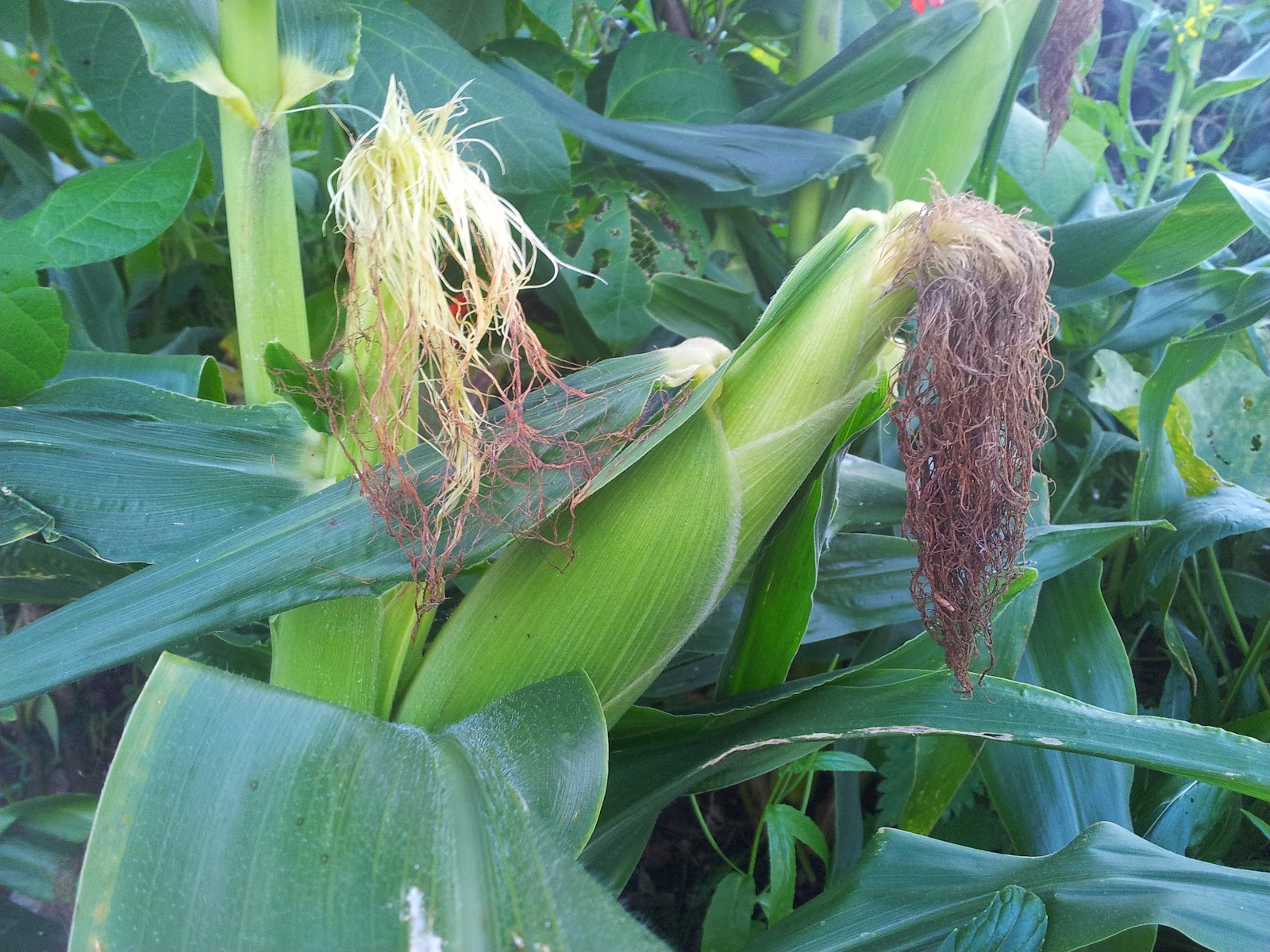
unripe on the left, ripe on the right
Last week I had my first home grown corn-on-the-cob. I knew from talking to other growers that the most essential thing is to cook it as quickly as possible after picking as the sweetness runs to starch very quickly in corn after harvesting. Going online to American websites it became very obvious that cooking sweetcorn is something the Yanks take very seriously, and more surprisingly they cook it in plain water, no salt added, as salt just toughens the corn kernels. They also give it a very short fast cook, bringing the pan of water to the boil, dropping in the corn and whipping it out as soon as the water returns to the boil! I gave it a bit longer, timing it for 5 minutes and it was cooked to perfection. Now all I have to do is wait for another ear to ripen so I can run up the garden with it and get it into the pot in record time. Corn is something that must be picked at the moment of absolute ripeness and not left on the plant beyond that as it toughens up dramatically. How do you know if it's ready to be harvested? the "beard" at the end of the cob will be quite ragged and brown, and if you peel back the outer husk at the top of the cob and sink a finger nail into a corn kernal a creamy coloured liquid should come out, if the liquid is clear it needs more time.

Wednesday, 26 September 2012

Main crop Spuds stored for the winter

Digging out the Tibets
September has two strong memories for me, one is the absolute dread of going back to school to the psychotic principle, (God rest you P Burns, I will visit you shortly to check the grave and make sure you're dead), the other is of evenings after school picking spuds up the hill or in the glen meadow, depending on where the potato garden was that year. One thing about living on farms ,especially small farms is that every field has a name, often in Irish to describe exactly where it was (in the days before GPS) and often associated with it's geography or uses. So our "gleann tori" as we call it is a corruption of Gleann Toibreacha, "field of the wells", (the whole field was awash with water springs so hence the name). "Tobar" is a well in Irish as it is in Scots Gaelic too, both are originally derived from the old Irish word "topar". OK I'm finished going off piste now. I love history, especially language history, it's fascinating.

eel worms dining in a spud
 On the finer days we would come home to a warm kitchen and my mothers dinner with instructions to eat quickly and change, Dad was digging the spuds up the fields and we were needed to help. For all the giving out I do I must say my father is an extremely practical man. We had a purpose built block concrete shed, with a concrete floor and strong metal door, entirely at the disposal of the potato crop. No windows to let in light that would turn the potatoes green, no leaks in the roof that let water in, no extremes of temperature and best of all no way a rat could get in to help himself to the harvest. It was perfect.

Black Bog-like priests socks only blacker!
That was a hell of a lot more spuds than I am growing now. It was enough to see us through the winter and into early spring. I don't have a shed, well I do- but its entirely the wrong type, wooden, warm, bright, reacting to extremes of weather by being ass kicking cold in the frost and boiling hot in the sunshine. I don't have a light free place in the house, the hallway faces North but has glass around the door. Its the only place I can store pumpkins and squash for the winter (with the radiator knocked off) but will it do for spuds?

Inspired by the fine warm day last Friday I took to clearing the main crop potato beds. If nothing else I was curious about the yields from the different varieties that I had as yet untouched; Tibet, Toluca and Black Bog. One long bed had black bog, Tibet's, Maris pipers and King Edwards planted in allotments. The tolucas had their own bed. I started on the black bogs and ran into trouble straight away. They were so black I literally couldn't see them in the soil! ridiculous but true and very frustrating as well. I ended up digging the same ground several times more than necessary just to check in case I missed any. Either way I'm expecting plenty of volunteers next year-it was impossible to find them all.The spuds themselves were small and extremely squashed looking with deep eyes. The yields were small too. Once I wiped the soil off them their true delicious deep purple colour came through. After growing and loving Edzell blues last year I couldn't wait to try out these guys.

one stalk of Tibets on the left V's
FIVE of Black Bog on the right!
Next were the Tibets and it was obvious right from the off that the yields here were phenomenally better than the black bogs next to them. Even when I was cutting down the foliage in this bed the stems were a strong bright green, unyielding to the blight that peppered their leaves. Underground there was little evidence of blight, but I found later on that many of them had suffered the excess appetites of eel worms and slugs, much as the King Edwards and Maris Pipers had done next to them. It struck me that this bed in particular had suffered the worst of the snails and eel worms, but of all the spuds set here the black bogs had the least amount of damage-maybe purple spuds don't appeal as much to pests?

Down in the Toluca bed things were not good, the stench of rotting spuds hit me every where I dug, and the yields were incredibly poor. When I was finished one 8x4 bed had only yielded one third of a bucket of spuds, and despite some of the tubers being a really good size I could see plenty of blemishes, signs of blight and slugs in equal measure. Not the results I had been hoping for when I planted them months ago, but again maybe that's all you can expect in such a difficult growing season.

Spuds drying off in the afternoon sun
I laid out all the spuds I had dug on the tops of the beds and left them to dry out in the afternoon sun. A short spell of sunshine is fine for the first bit of drying but by the evenings end I gathered them all into buckets to go inside for "processing" next day.

Last year I bought some Hessian sacks and had been trying them out during the summer, storing first Earlie's for weeks at a time in the utility to see if they went green. The results were great-no green spuds! so next morning I lined up my sacks, sat at the back door in the sun and began the incredibly tedious job of cleaning(you must take all the excess soil off the skins), inspecting each spud and organising them into three categories; "for storage", "slightly damaged" and "for the compost heap". There really is no escaping this job. If I learnt one thing from my mother in law and her apple picking each autumn it's that you never store anything damaged long term, it only serves to rot the rest. So only the most perfect spuds can make the Hessian sack. All imperfect spuds go into the kitchen bucket to be used or given away in the coming weeks. While those blighted, rotting or tunnelled into oblivion must be cut up for the compost heap. Its funny I never remember doing this job at home, but in some shape or form we must have.

compost, keep and store long term-the processing plant
Isint it ironic that I worried where I would store all my main crop spuds for the winter when I was planting them and ended up using a third of one Hessian sack for long term spud storage?! As you can see from the photo most of the spuds need to be used up in the coming weeks and I feel I can't really pass them on to other people because they are so populated by eel worms and slugs that only another gardener wouldnt mind the inconvenience of digging them out before cooking! Imagine the horror of my inlaws having eel worms crawl out as they are peeling them?! It's almost worth doing-but only if I can stay around to watch.

PS; tried the black bogs, yes a fantastic purple colour with lovely markings on the inside, but sadly lacking really great flavour.

in the kitchen Black bog shows its true colour

beautiful white flesh on the inside

The Science of Spuds-Taste Testing King Edwards

Worlds smallest yield of potatoes-King Edwards
Don't you just hate experimental science? all that poking and prodding, control groups and paperwork, and for what? to tell us something that will easily be disproved next month, just so a whole bunch of people in white coats have yet more reasons to apply for more funding and squander it on more scientific research! Arrrrrraggggh!!

I'm more of a fan of the type of experiment you can conduct yourself at home, no special equipment required. So today I tested the notion(that I keep seeing and reading everywhere) that the King Edward is the worlds best baking spud.

Result; No it's not.

How easy was that?!

As a crop of potatoes to grow the King Edwards did very poorly, caught blight early and had tiny yields when dug. The spuds themselves in common with a lot of other main crops this year were beset by tunnelling slugs, eel worms and in a very few cases rot brought on by blight. It's hard to judge a whole spud variety by an exceptionally bad year but then in fairness spuds that did better must be better spuds right? otherwise the point of trying out lots of different varieties is lost. I mean how many times should you grow the same variety of spud to figure out if its worth growing again or not? Life is just too short.

Pretty when the soil came off
Once I got a few washed they looked very impressive; a lovely pink flush on creamy white skin blemished here and there by small tunnels (slugs and eel worms). I cut the bad bits out, washed and dried them, then rolled them in very good olive oil and sea salt, popping them into a very hot fan oven, 200c, for 30 minutes.

When they came out the outsides were lovely and golden, the insides soft and a little fluffy. They could be fluffier and maybe I should have left them in longer but they were actually done. I ate the lot, without anything other than some butter to compliment their skins covered in sea salt. Yes they were tasty, but worlds best baking spud?- I don't think so. If it's about their flavour-there was no amazing potato taste to report. If its about how they technically bake in their skins-yes they do look lovely but I'm not planning to look at them I want to eat them!

looking nice and golden in the plate
No doubt at least one of you completely disagrees with me on the subject of King Edwards and maybe that's the whole point too. Different people like different things, why else did so many varieties of spuds get developed in the first place? Read my scientific report with a good pinch of (sea) salt and don't let it put you off trying them out for yourself.

By the way there is a really thorough baking spuds experiment done on this blog if you have the time to read it word of mouth blog

Friday, 21 September 2012

Cold night ahead

the sun sets on climbing beans
Just in the door from covering the pumpkins with fleece after the weather forecast on rte1 promised ground frost tonight .sadly it looks like the start of frost watching season, far too early for my liking.keep an ear out if you have pumpkins or other frost tender crops still in the ground.if you don't have fleece use newspapers to cover them.